

Having attended the World Biogas Expo in Birmingham in July, I came away feeling optimistic about the direction of travel of the anaerobic digestion (AD) and biomethane sector.
There was plenty of discussion about digesters, upgrading technology and the latest equipment. But what struck me was that the conversation has moved on considerably from simply proving that anaerobic digestion works.
The bigger question now is: how do we deliver more of it, and how do we upscale?
That means joining up agriculture, food waste, energy infrastructure, gas networks, transport, industrial users, finance, planning and environmental regulation. AD increasingly sits at the intersection of all of those facets.
Energy Security, Waste and the Role of AD
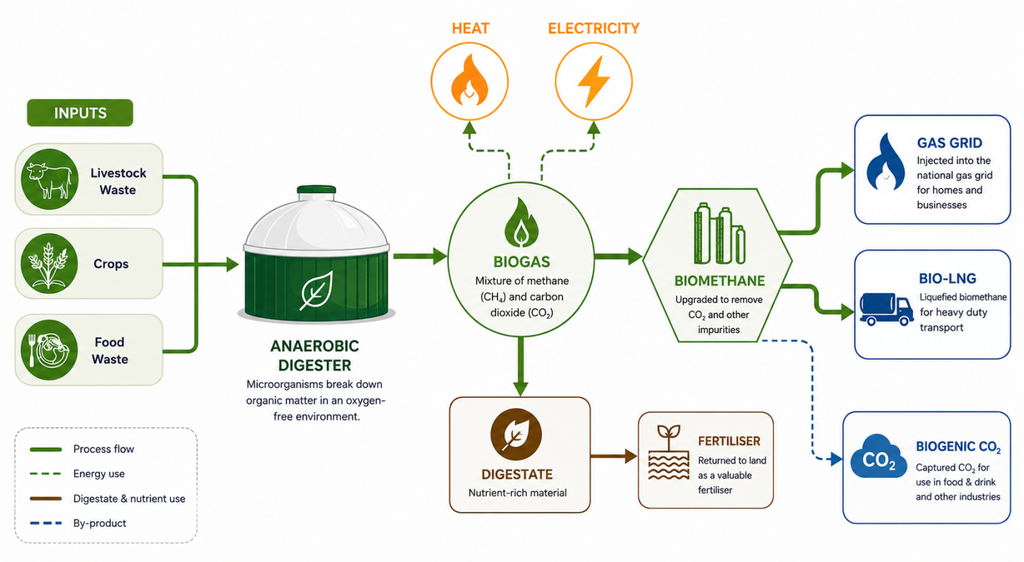
At its simplest, anaerobic digestion takes organic material and breaks it down in the absence of oxygen, producing biogas and digestate. That biogas can be used directly to generate heat and electricity via a combined heat and power (CHP) plant, or it can be upgraded by removing carbon dioxide and other impurities to produce biomethane – a renewable gas that can be injected into the existing gas network or used as a transport fuel, as an effective drop-in alternative to fossil fuels.
What makes AD particularly interesting is that it is both an energy and a waste-management technology.
The UK has made huge progress in renewable electricity, but gas still plays an important role within the energy system. Biomethane offers a way of replacing a proportion of fossil natural gas with a domestically produced renewable alternative, while making use of materials that might otherwise be treated as waste.
The Digest of UK Energy Statistics (DUKES) 2026 shows that the share of UK electricity generation from renewables reached a new record 52.1% in 2025. Fossil fuels still accounted for 32.3% of generation, with gas remaining the principal fossil fuel source of UK electricity generation at 31.8%.
At the same time, UK energy production remained at a record low and net import dependency stood at 43.3%, with more than 90% of energy imports comprising oil and gas. With the uncertain geopolitical situation, any efforts to minimise gas importation can only be a good thing in improving the UK’s energy security.
That is why the energy-security angle feels increasingly relevant and, arguably, increasingly effective. With greater political uncertainty around the pace and cost of the UK’s Net Zero transition – and growing challenge from parties on the right of UK politic spectrum – the case for biomethane does not need to rest on decarbonisation alone. It can also be framed around domestic energy production, resilience, reduced reliance on imported fossil fuels and better use of UK-derived waste and agricultural feedstocks. Biomethane has the potential to command broader cross-party support and prove more resilient in a continuing volatile political landscape, which is always problematic when significant long-term investment in a sector is required.
Whilst the National Energy System Operator (NESO) expects overall gas demand to fall over the longer term, the gas grid will remain an important part of the UK’s energy system for some time. The NESO Future Energy Scenarios (FES) 2025 sees biomethane supplying up to 38% of gas demand by 2050. One of the key talking points at the World Biogas Expo was the growing role for gas-fired microgrids and CHP systems in some high-demand developments, particularly data centres and other energy-intensive uses where electricity demand is rising faster than available grid capacity.
At the same time, there is a major waste challenge to solve. The DESNZ UK Methane Action Plan highlights the significant methane emissions associated with biodegradable waste in landfill, while the DESNZ Biomass Strategy supports biomethane production from AD, including from food waste. AD therefore offers a unique opportunity to divert organic waste from landfill while producing renewable energy at the same time.
The planning system is also supportive. The National Planning Policy Framework (NPPF) requires planning policy to support the transition to net zero and renewable and low-carbon energy (Paragraph 161).
The Government is now looking to strengthen that support further. The December 2025 draft NPPF, published for consultation but expected to be issued in final form later in the year, proposes through Policy W3 that ‘substantial’ weight should be given to the benefits of renewable and low-carbon energy development, specifically including its contribution to UK energy security, economic development and the transition to net zero. That is a notable step up from the current wording and, importantly, expressly brings the benefit of energy-security into the planning balance.
More Than Just Renewable Natural Gas (RNG)
A modern AD facility can increasingly be thought of as a multi-output circular economy facility.
Biomethane is the obvious product. Raw biogas typically contains methane and carbon dioxide. Once upgraded, the resulting biomethane can meet gas-network specifications and be injected into the national gas grid, replacing fossil natural gas.
Alternatively, biomethane can be liquefied to produce Bio-LNG (bio-liquefied natural gas), providing a renewable fuel particularly relevant to heavier transport applications where electrification is proving a difficult problem to solve.
There is also biogenic CO₂.
Historically, the carbon dioxide removed during biogas upgrading has been viewed as a by-product of the process. Increasingly, however, there is an opportunity to capture and refine that CO₂ for use by industries that need a reliable supply of carbon dioxide, including the food and drink sector. This is increasingly relevant given DEFRA’s recent call for evidence on strengthening the resilience of the UK CO₂ supply chain, which is looking at ways to improve the security and sustainability of food and medical-grade CO₂ supplies across critical sectors.
This changes the economics of the plant. Biogenic CO₂ is not necessarily something simply to be managed; it can become another useful product leaving the site, generating an additional income stream.
And then there is digestate.
Digestate contains valuable nutrients and can be returned to agricultural land as a fertiliser, reducing reliance on manufactured fertilisers. Again, that adds another circular element (and income stream) to the process: nutrients contained within the original feedstock can ultimately be returned to the soil.
For context in 2025, the UK imported £1.24B of fertilisers, being the 61st most imported product (out of 97) in the UK. Reliance on foreign imports has hit the agricultural sector hard – the ongoing Middle East conflict has significantly increased fertiliser costs, effecting UK imports. Disruptions in the Strait of Hormuz has throttled global supplies, causing major price spikes of 40% to 70% and threatening the supply the UK agriculture sector needs.
The diagram below illustrates the point well. AD sits at the centre of a system that can produce renewable gas, heat, electricity, transport fuel, fertiliser and potentially a usable biogenic CO₂ stream.
The more value that can be recovered from every tonne of feedstock, the stronger the overall proposition becomes.
The Question of Feedstock
This was one of the key topics discussed at the Expo.
Plants need a secure and consistent supply of material, and feedstock availability and pricing will always influence whether an individual project stacks up commercially.
But there is also a huge potential resource across both agriculture and the waste sectors.
Agricultural AD can make use of materials such as manures and slurries alongside agricultural crops and residues. For farms, AD can provide another income stream, create renewable energy and offer a way of managing organic material while producing digestate that can be returned to the land.
Food waste is another major opportunity.
The Waste and Resources Action Programme (WRAP) reported in 2022 that 58% of UK food waste came from households causing 16 million tonnes of greenhouse gas emissions.
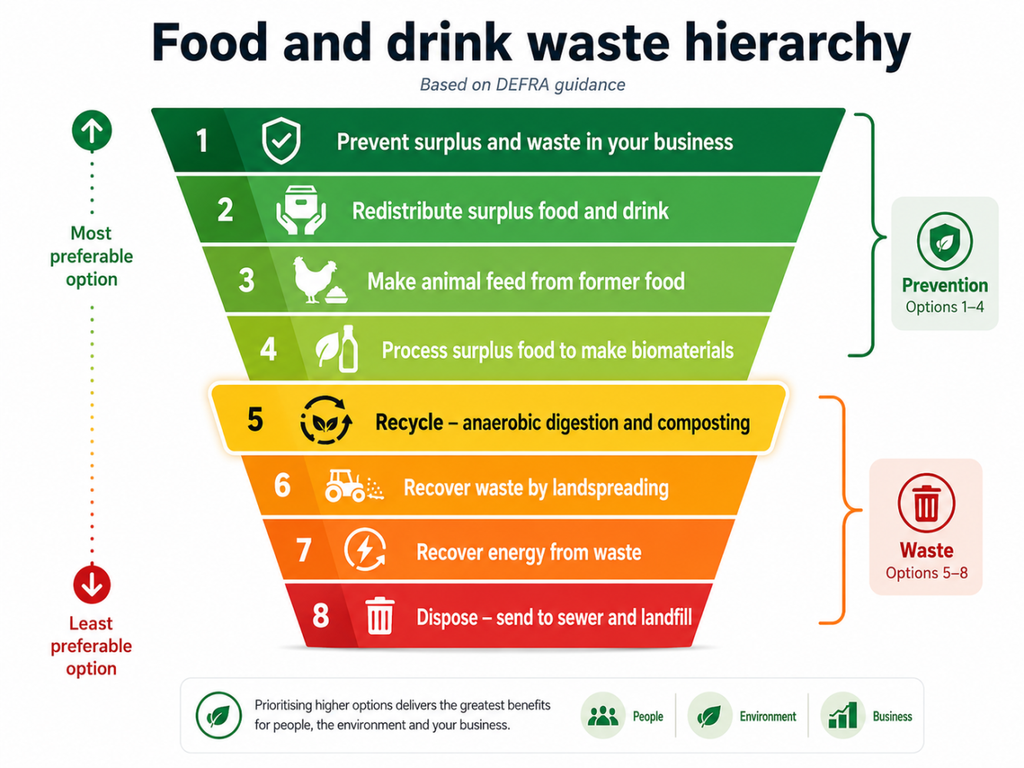
Within the UK food and drink waste hierarchy (Figure 2), AD is considered ‘recycling’: more preferable than incineration or landfill which release more GHG. Estimates of household food waste processed by AD in the UK are uncertain, but WRAP reported an operational capacity of 3.2 million tonnes that could be used to process food waste in 2019.
This is where DEFRA Simpler Recycling becomes particularly important.
Separate food-waste collections are being rolled out widely across England, including weekly household food-waste collections. This will progressively create a larger and more consistent source-separated food-waste stream, ideal for the AD sector.
Collecting it is only half of the equation.
Once we have separated millions of tonnes of organic material from the residual waste stream, we need infrastructure capable of dealing with it.
That means AD facilities, but also the sorting & collection depots, transfer infrastructure and associated logistics needed to move food waste through the system.
So, there is an interesting convergence taking place: energy policy wants more renewable gas, waste policy wants biodegradable material moved away from landfill and incineration, and the agricultural sector is looking for opportunities around diversification, nutrient management and energy.
AD connects all three and provides a ready-made solution.
Getting Projects Consented – Planning & Permitting
Of course, none of that matters if projects cannot be delivered.
This was another key theme I took from the Expo. As the sector matures, planning and permitting are increasingly part of the delivery challenge.
Commercial AD plants will generally require planning permission and, where waste is being accepted and treated, an Environmental Permit will also normally be required.
The planning issues themselves can be understood and mitigated through planning and technical input, but they need to be considered early in the project cycle.
Traffic is a major consideration because an AD facility is ultimately dependent on bringing feedstock in and moving products out. Landscape and visual effects can be important, particularly given the scale of digesters, storage tanks and associated infrastructure. Odour and air quality need careful consideration. So do noise, ecology, drainage, flood risk and the relationship with nearby residential properties – not to mention potential impacts on heritage assets or the additional planning policy considerations that can arise such as if a site is located in the Green Belt.
Then there is Environmental Impact Assessment (EIA) to consider.
AD facilities involving waste treatment generally fall within Schedule 2, paragraph 11(b) of the EIA Regulations – “Installations for the disposal of waste”. EIA Screening is required where the relevant Schedule 2 criteria are met.
Importantly, crossing those thresholds does not mean that a project automatically needs a full Environmental Statement. It means that the development needs to be robustly screened to establish whether it is likely to result in significant environmental effects.
For developers, that makes early site appraisal work and selection, technical advice and EIA strategy particularly important, so the planning strategy can be fixed early in the project timeline.
Good project management will result in a planning application having robustly addressed the questions such as HGV routing, landscape effects and mitigation, odour receptors or whether an EIA is likely to be required. Those issues should be considered and assessed with the Local Planning Authority and other key stakeholders from the outset.
How Enzygo is Leading in Planning and Permitting Services
This is an area where Enzygo’s multidisciplinary model works particularly well, allowing planning and permitting advice to be supported by in-house technical expertise from the outset.
Enzygo can draw on decades of experience across the waste and energy infrastructure sectors, helping developers anticipate and navigate issues early.
We support energy and waste developments from early site feasibility and planning strategy through EIA Screening, planning applications, technical assessment and environmental permitting.
Our planning team coordinate the overall consenting strategy while drawing directly on our in-house specialists across transport, landscape, ecology, air quality, noise, flood risk and drainage, geo environmental and environmental permitting.
This means we identify constraints early, scoping the right level of assessment, enabling technical findings to influence the site design so they don’t become a planning problem once an application is submitted.
We also have extensive experience working across challenging planning contexts and environmentally sensitive locations, including Green Belt, with excellent success in demonstrating land parcels as ‘Grey Belt’.
Final Thoughts
The technology is established. The opportunity is increasingly clear and growing. The challenge now is delivering the infrastructure needed to turn that opportunity into operating financially successful projects.
For me, that was probably the main takeaway from the World Biogas Expo.
And planning and environmental consenting have an important role to play in making that happen.
If you are developing an AD or biomethane project, have an interest in the sector or would like to discuss site feasibility, planning, EIA or environmental permitting, please feel free to get in touch our Principal Planning Consultant, Tom Baguley, tom.baguley@enzygo.com.